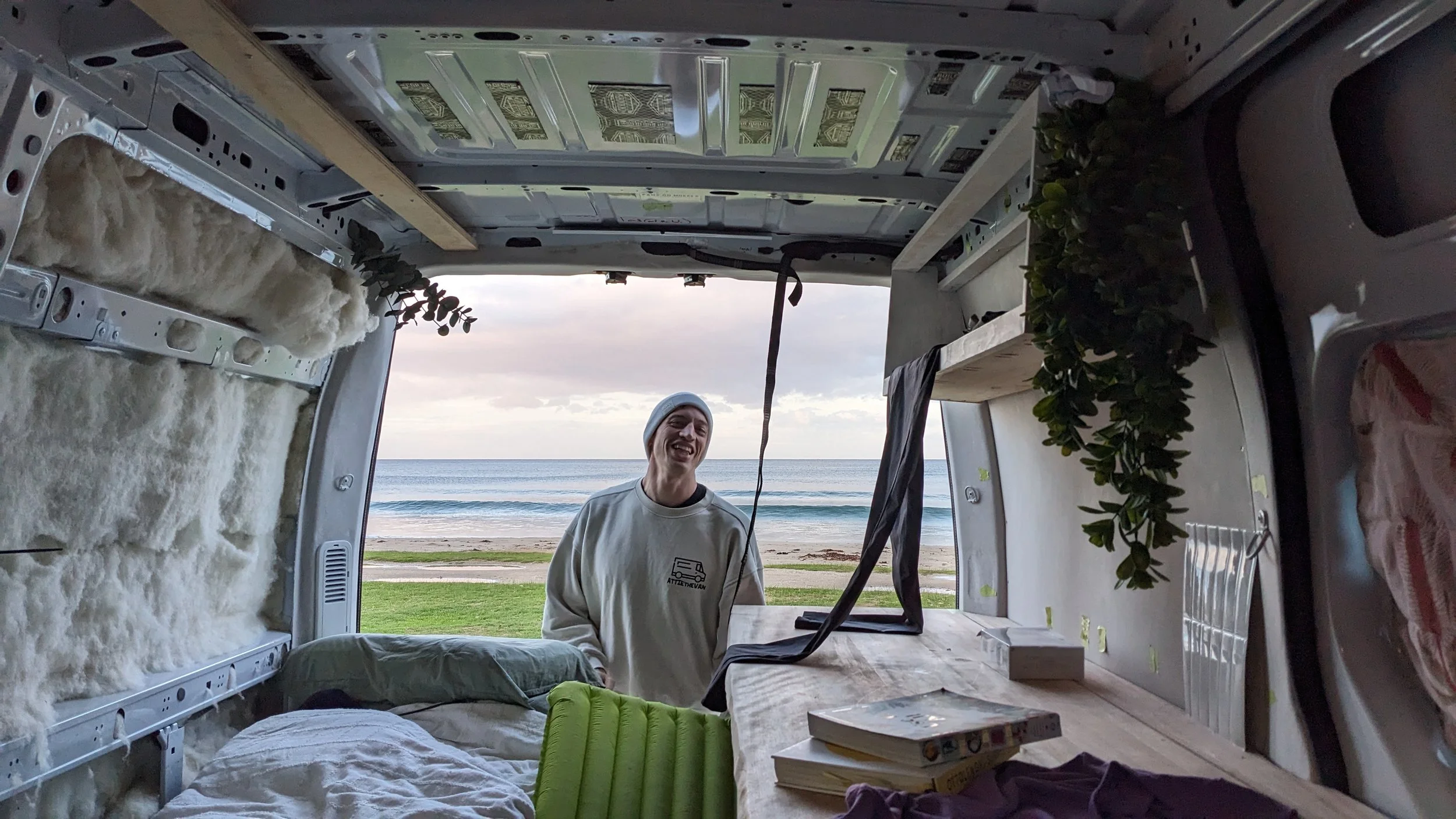
Stealth Camping In A Van Around Australia
A campervan is one of the best ways to travel.
But it’s not always easy to find a safe, comfortable, and affordable place to sleep for the night, especially near cities and towns.
Whilst nothing beats a night in the forest or at the beach, stealth camping can be a convenient way to stay in places that are not specifically designated for overnight camping.
This is us stealth camping at the botanical Gardens in Melbourne after the Aus Open tennis.
The goal isn’t to be deceptive like some people think, but rather avoid attention, sleep peacefully, and leave no trace behind.
There are a few basics to stealth camping. Over the years, we’ve come up with some ways to find a good stealth camp spot for the night – and we’re sharing them all!
Let’s start with a pretty important question…
Is It Illegal To Stealth Camp In A Van?
Well, it depends on where you are.
In Australia, the laws around sleeping in your vehicle differ between each state and territory as there is no overarching federal law:
While these differing laws are frustrating, it’s easy to understand why they are there.
If camping was legal in every popular tourist spot, everyone would probably want to camp there and amenities like toilets, bins, and shared spaces would be overrun.
The best way to avoid a fine is to be informed on local laws when you travel.
Note, laws around sleeping in your car may be different for anyone intoxicated with drugs or alcohol.
Our Guide To Stealth Camping In A Van
Stealth camping can take a bit of trial and error.
Sometimes it’s easy, but other times you’re driving around and around at night trying to find somewhere to sleep.
We’ve been there, so we got some strategies that help us find a good spot for the night.
Here are our 11 tips for stealth camping in a van:
1. Build A Stealthy Van
If you ever plan on stealth camping, it’s a good idea to design a stealthy van. For example, we have flexible low-profile solar panels so they’re harder to see, we concealed our shore power outlet inside the van, and we made black-out window coverings (not curtains though) to stop people peeking in (and not for the front windows because this could potentially draw more attention). Our van isn’t 100% stealth as we do have a skylight, but we’ve done what we can to draw less attention. And if you park strategically, everything is even less noticeable!
2. Plan For BEING Stealth
If you plan on stealth camping on your trip, consider how the outside of the van looks. For us, we intentionally don’t have roof racks, an awning, bikes, stickers, etc. on the outside of our van. Of course, we would love to have these things, but we have prioritised being inconspicuous as it gives us peace of mind because we stealth camp a lot when travelling.
3. Arrive Late And Leave Early
Your stealth parking spot should be for sleep only. Wherever we end up stealth camping, we always aim to arrive late (preferably just or after it’s dark, although not too late) and leave early (ideally before people normally start to wake up). This way, there are less people around to notice your arrival and departure. And early morning starts are good for the soul anyways!
4. Set Up BEFORE Arriving For The Night
It’s tempting to get ready for bed at your camping spot, but brushing your teeth in a carpark with lights blazing isn’t exactly stealth. Instead, set up for the night somewhere nearby including eating dinner, preparing the van, and turning off all the lights. We call this getting into “incognito mode”. That way, you can take all the time in the world to wind down for the night before you drive to your final sleeping spot.
5. Scout Your Sleeping Spot In The Daytime
Whenever we plan on stealth camping, we always try to scout the location when it’s still light. That being said, we know it’s easy to get sidetracked adventuring and end up arriving at your destination well after dark. But, where possible, scout your spot in daylight so you can assess everything around you. That way, you’ll be able to see anything that might increase your chance of getting spotted.
6. Avoid Getting Out Of The Van Once You’ve Arrived
When we stealth, we avoid getting out of the van once we’ve arrived. We climb through the van rather than opening any doors and make sure we are ready for sleep before we arrive, including a quick bathroom stop. Needing the toilet overnight is one of the worst parts of stealth camping. You don’t really want to be dashing out of your van in the middle of the night to a public toilet. Getting a toilet on board is a great solve, but a She-Wee or a pee bottle of course works too!
7. Always Look At The Parking Signs
Sometimes we find ourselves in places with parking restrictions, usually when we want to be near the hustle and bustle. Wherever you end up, always make sure to read the street signs. This includes any time restrictions, overnight rules, no parking signs, or street cleaning times. As annoying as they are, rules are rules so make sure to follow them to avoid a fine!
8. Blend In
To avoid detection, we try to find places that have at least one or two other cars nearby because it’s easier to blend in. Better yet if there’s another work or commercial van nearby. However, we avoid parking near other campervans (although it’s fun to be around other campervaners, it could potentially draw more attention to you when you stealth camp).
9. Consider Your Parking Direction
If the opportunity is there, try position the van strategically. For example, if you are near foot traffic, maybe park facing outwards to reduce visibility into the van. Or, to hide your out-of-state number plates and any condensation, parallel park between two cars. In some cases though, it might be less noticeable to just drive straight into a parking spot rather than reversing, such as when arriving late at night.
10. Add Decoys
To look more like a work vehicle (and not a campervan) we add “decoys” on the dashboard like a measuring tape, random papers, a hat, or a clipboard. We recently got a car magnet that says, “Paws On Wheels” to stick on the outside of the van and blend in more like a work van.
11. Trust Your Gut
When it comes to stealth camping, trust your gut! We’ve driven away from the “perfect spot” when something didn’t feel right, even if that meant a bit more driving when all we wanted to do was snuggle up in bed. Always have an exit plan and a back-up location (or two) just in case.
How To Find The Best Spot To Stealth in a van
While camping in a national park is unbeatable, sometimes you just want to be in and around the city. So where is the best place to park overnight in town?
These are our top 5 favourite places to search for when stealth camping:
1. Car Dealerships
No one would look twice at a Renault van that is parked next to a Renault dealership. So we often look for Renault or other car dealerships like Toyota or Ford when arriving in a new town. It’s easy to blend in and we usually feel right at home. It doesn’t work everywhere because the dealerships are usually in larger cities, but it’s a good place to start!
2. Bars
Stealth camping near bars has become a recent favourite for us. It’s pretty normal for people to leave their car overnight at a bar and just get a taxi home, so there are usually cars around all night. Having lots of different cars around helps hide the van so we’ve slept really well when we’ve done this. Cheers to a good sleep!
3. Small And Mid-Sized Apartment Buildings
Because apartment buildings are so densely populated, there are often lots of different cars parked around them. We usually look for mid-sized apartment buildings that have street car parking – not the big apartments because they commonly have internal parking, but also not too small either because they don’t offer enough anonymity. Just be aware that residents might be able to see the top of your van (i.e., solar panels, fans, rooftop decks) which could be a bit of a giveaway that you’re inside.
4. Gyms
Gyms are commonly in or near shopping centres or strips, so there are often always various cars around (especially if the gym is open 24 hours). We have an Anytime Fitness gym membership and often stealth camp near the gym when we travel. So long as we park near other cars, it’s usually pretty inconspicuous. And you can just roll out of bed and head straight to the gym for a workout in the morning (and a hot shower afterwards!).
5. Parks Or Sporting Grounds
If you find the right one, parks and sporting grounds can be a great place to stealth camp. They have the added bonus of being a good place to exercise in the morning or have a picnic breakfast. However, if there are a lot of single family homes around, you might stand out like a sore thumb, so be careful when choosing one. Try find one with apartments or stores surrounding it to help with blending in.
Try for something like this.
And not something like this.
Other places to keep an eye out for:
· Car Mechanic/Repair Shops
Like with the dealerships, car mechanic shops usually have lots of different cars parked around them. Adding a van to the mix is just another car so can you blend right in.
· Shopping Strips
Around shopping strips, there are usually lots of cars and not many people paying attention. We’ve found that usually makes for a peaceful night’s sleep! You just have to watch out for mall security.
· Industrial Areas Or Construction Sites
It’s normal for a van to be parked near construction sites or industrial areas, especially one with a clipboard on the dash. Pick and choose the location wisely though and don’t block any access points.
· Hospitals Or Health Centres
In smaller towns, district hospitals or health centres with street parking can be a good spot. However, be respectful about it and avoid getting in the way of any emergency services.
What To Avoid When Stealth Camping
Although stealth camping offers a lot of freedom, there are a few things to be mindful of:
Don’t Disturb The Locals
Our golden rule is “Don’t disturb the locals”. This means being quiet, never leaving any mess behind, and not parking right outside someone’s front door. If you don’t disturb anyone, no one should care if you’re stealth camping!
This is a permit zone and right outside someones front door, so we wouldn’t be stealth camping here.
Leave No Trace
When it comes to stealth camping, it should be like no one knew you were ever there in the first place. Park thoughtfully, collect your rubbish, and save any grey water for a proper dump site.
Avoid Parking On A Main Street
While we like to park near other cars, we avoid parking on the main street in town. Instead, we usually opt for a side street off the main street. Otherwise, there is too much traffic, which is noisy and can increase the likelihood of you getting spotted. And it doesn’t make for a restful night!
Avoid Overly Residential Areas
While the suburbs may be more peaceful, we still try to avoid them — particularly if there are single family homes on both sides. It’s really hard to blend in because most people know their neighbours’ cars, so a random van appearing might be suspicious. Instead, we try to find apartment complexes or parks with street parking.
Don’t Stay Too Long
Although it would probably take an observant person to notice your van, avoid parking in the same spot more than once. We always move parking spots when staying in town for a few days so that we are in a completely new location each night.
Don’t Park Next To Vehicles That Look Like Campervans
While we love making friends on the road, we try to avoid parking near vans that look like someone is living inside. That is because we are doing the same thing! And two of the same could potentially raise suspicions. Instead, we opt for parking near other cars or work vans.
Avoid Parking Outside Certain Organisations
This is probably a bit obvious, but pay attention to avoid accidently parking outside places like police stations, courthouses, law offices, council buildings, school zones, government facilities, and anywhere that might have patrolling security or cameras. You might be pushing your luck otherwise!
Safety In Stealthing
Crime prevention is always something to consider when stealth camping. Your campervan is your home, and you are usually carrying everything important to you inside. It’s a good idea to invest in security measures, like an alarm system, cameras, internal locks, and hidden storage.
We also try to be aware of where we park and avoid leaving any valuables within sight. We try cover all our windows and always lock the van when we leave it. Overnight, we put the keys in an easy spot to grab at night and have a getaway plan so we can quickly drive away if we need.
Free Camping
Although we love stealth camping, we always look for a free campsite first — mainly because camping in nature is better, especially as it doesn’t have the risk that someone is coming to knock on the door in the middle of the night!
We use a few apps like Wikicamps and Hipcamp, and there are Facebook groups like Vanlife Australia. But actually, our favourite way to find a free campsite when we travel is with the Camps Australia Wide book — it’s old school but it comes in very handy when you have patchy internet or forget to plan ahead.
We got this book from a friend (thanks Ang!) and never travel without it.
Sleep Well Whilst Stealth Camping
There are so many wonderful places to explore in Australia, from the national parks to the coast.
But sometimes stealth camping in a city is simply the best option on your adventure.
People seem to get so cross at people trying to LEGALLY sleep in their van on the street.
Maybe it’s because they’ve seen other campervaners abuse the trust of communities by leaving trash or setting up camp on the nature strip.
But that isn’t stealth camping!
The keyword is stealth.
Stealth camping is about getting rest overnight when travelling and leaving without a trace.
While it’s taken a while to find a strategy that works for us, we love the freedom and lifestyle stealth camping offers.
Just make sure to check the local laws and regulations to avoid that early unwanted wake-up call!
This information is for general purposes only and is not intended legal advice. Always check the relevant state or territory laws or seek professional legal advice.
Is Building A Van Hard?
Wish more people would rant about the things that go wrong in a van build? We share the setbacks, moments of doubt, and hard-learned lessons that make building a van so hard.
Yep!
Building a van is really really hard.
But it’s worth it.
The whole process of van building can be overwhelming.
The road is bumpy with setbacks and obstacles and it tests your resilience at every turn.
sometimes It feels like nothing is easy.
A lot of effort gets invested for no real return.
All this equates to slow progress or, sometimes, zero progress.
Which is the antithesis of motivation.
Suddenly, three months have gone by with nothing to show for it.
this isn’t meant to Discourage other van builders.
There’s a lot of glamour around van life.
But it’s not all hikes, smoothies, and sunsets.
We want to make sure to share all the sides to our van build story.
Particularly the moments that have driven us a little bit insane.
Because we know that other van builders are probably feeling overwhelmed, sad, and frustrated too.
And we can relate.
We’ve been on the verge of quitting too many times to count.
But we keep coming back.
So there must be something in it.
Hopefully ranting about our problems helps other people feel better about their own builds — and how to learn from our mistakes.
The struggle is real.
for us, we HAD A few big problems in our build.
Whilst these problems are specific to our situation, it’s almost inevitable that things won’t go as planned in a van build.
Sh*t happens and it can sap the energy from the whole project.
You might start to say things like ‘Should we sell the van?’ and ‘I think we should just sell the van’.
And question your skills, if you’ll ever finish, and why you even started a “stupid” van build in the first place.
The voice of reason is sometimes barely loud enough in these moments.
While we aren’t necessarily suggesting a cure, there must be some kind of solidarity in sharing these sh*tty experiences.
Let’s get into ours.
Problem 1: Converting our passenger seat
When we bought the van almost a year ago, we were under the assumption it would be simple to change out the passenger bench seat for a single passenger seat.
We wanted to be able to easily walk between the cabin and the cargo area.
Easy peasy, right?
Little did we know how wrong that was.
For months, we called different companies, waiting to hear back whilst they checked with this person or another to see if it could be done. There are strict laws about seat conversions, and any change must be approved by VicRoads.
Our contact list to find someone who would meet the criteria was long, and included Renault, Tech Safe Seating, VicRoads, a myriad of seating companies, car companies, wreckers, and other businesses both locally and interstate.
It felt like we called everyone in Australia, trying to find a reasonable solution for this seat.
After it all, it seemed like it wasn’t going to be financially feasible.
We would just have to continue to ungracefully clamber through from the front to the back of the van.
[Although, it is actually pretty fun to watch PB get his two metre body through the small gap between the front seats.]
So it just ended up being a game of sitting and waiting.
Our problem chair — the middle seat!
Problem 2: Finding An Electrician
The second problem was finding an electrician.
After struggling for months to find an autoelectrician that installed Victron, we finally had a meeting with someone we thought was a great match.
Afterwards, we were feeling over the moon with excitement.
In the days and weeks that followed, we waited patiently for a quote, sending in the meantime all the documents and plans he had requested.
But it got to one month later, then two, then three. Still, no quote. We called and emailed and called again, and nothing.
Months came and went.
We got the promise ‘It’s at the top of the list’, but heard nothing more.
It was understandable there was a backlog, particularly because of after COVID-19. But six months after our appointment, we still hadn’t got a single document or even heard a word from the electrician.
We were back at square one.
From so high to so low, it was hard to wrap our heads around it.
Sketches from our meeting — thought we were onto something!
Problem 3: getting The Right Insulation
The third big problem was a frustrating one: insulation.
We’d done a lot of research into insulation.
In fact, it was the first thing we started researching back on Day 1 of the build.
As we want to make our van as ecofriendly and self-sufficient as possible, we were trying to find pure wool insulation for our van. Which is harder to source than you would think.
20 years ago, it was the go-to for houses and buildings. But nowadays, it’s just too expensive to manufacture in Australia compared to the other alternatives like fibreglass or glass wool.
When we discovered no one in Australia sells pure wool insulation anymore, we even looked overseas to New Zealand and America. But no one would ship to Aus, and Australia has some pretty strict insulation laws anyways.
We found a local alternative insulation that was a combination of recycled wool and polyester. It got our hopes up, but the suppliers kept pushing back the arrival date of new stock and didn’t really seem interested in customer service.
After months of waiting, we put it into the ‘too hard basket’.
Waiting for insulation.
After these problems kept piling up, it seemed like we would never be done.
Amongst work and life, we’d tried to do as much as possible to make things happen.
But we just couldn’t get any traction and our problems kept compounding.
We felt like throwing in the towel too many times to count.
the good vibes were no longer good.
So, Why didn’t we give up?
We’ve asked ourselves this question a lot.
Because despite all the problems we’ve encountered in this build, we keep coming back for more.
While building a van is hard, it’s also rewarding.
No matter how long it takes or how small the progress is.
And we just keep thinking about the first real trip we’ll get in the van when everything is done.
And all the trips after that.
The struggle feels worthwhile.
We also found that stepping away from the build helped a lot.
After making no progress on these problems, we took a trip (not in the van).
Weirdly, we got more things done in those few weeks than we had in the previous three months.
Perhaps we needed the distance.
Perhaps we needed a break.
Or perhaps we needed to stop stressing and pushing for things that were out of our control.
Whilst the trip didn’t necessarily fix out problems, things did start to line up again.
It gave us some clarity and, importantly, a few solutions:
We finally got the seat conversion (although this is a whole other story).
We found an amazing electrician and got an electrical system up and running.
We sourced and installed 100% sheep wool insulation in the van!
We also got another foster dog, and puppy cuddles always help!
We’ve learnt a lot of important lessons.
The motivation is back and everything feels possible again.
Of course, we’d do everything differently next time.
But it’s a nice break through the clouds.
So, Is It easy Converting A Van?
Absolutely not.
Did we think we would be sitting here, almost a year later, with so little progress on the van?
Nope.
But Are we going to keep going regardless?
Heck yes.
And don’t worry, we have no plans to sell the van.
Choosing Attie the Van
“A campervan is a five billion star hotel”
Attie is Our Renault Master Medium Wheelbase Campervan.
Our van Attie!
so Why Did we choose a Renault Master van?
Hmm, good question.
We had been dreaming about buying a van for years.
And it wasn’t a decision that we made lightly. It took us a long time to finally jump all in.
The plan to buy a van had been in motion for almost 10 years. We had been saving and planning and dreaming for a very long time.
But when we were finally ready to invest in a van, COVID-19 came and shocked the world. The effects COVID-19 pandemic played a part in our decision to ultimately get Attie the Van.
In any case, we finally decided to put our life savings into our dream van in October 2021.
And we called her Attie the van.
So, how did we get here?
Well, here’s the story of Attie the van.
It all started with a caravan.
The original plan was to buy a caravan.
A long time ago, my parents took my brothers and I around Australia for three months in a caravan, and it felt like pure freedom (more on that: Dreaming About A Van).
There are heaps of awesome things about caravanning, but a caravan is a tricky beast.
At some point, we pivoted towards a campervan. We liked that it was all-in-one, and that we weren’t necessarily tied to a caravan park or campsite.
So, we were onto a campervan.
We loved the adventures and the freedom of movement that a van could give. Over the years spent dreaming of having a van, we collected ideas and resources (read more: Before We Bought Our Van (Part I)) and tested a few vans (read more: Before We Bought Our Van (Part II))
But would we go with the Toyota HiAce? Or the larger Sprinter van? We had no idea.
There were a few comparable options on the market that we considered:
The Mercedes Sprinter
There are a lot of Mercedes Sprinters on the road. The Sprinter a versatile van, very stylish, and a lot of people convert them into beautiful functional campervans. Although it seemed like a great van, we didn’t go for this option because of the badge and the reported mechanical expenses. It’s still one to consider for the next build though!
The Ford Transit
The Transit is an icon. It’s a well-loved van, and has a lot going for it. But we weren’t convinced on the reliability after we read a few negative reviews about some mechanical issues. It would still be one we’d consider for a future van, especially because the cargo height is great.
ThE Fiat Ducato
Fiat is Italian, and the square shape is advantageous for a van build. It looks similar to the Ram ProMaster in America, and that’s because it’s effectively the same van. Fiat bought Chrysler during the recession a decade ago, and remarketed a version of the Ducato as the ProMaster, so the Ducato might look oddly familiar to overseas van lifers.
The Volkswagen Crafter
The VW is a German classic. You often see the smaller VW Transporter, especially in coastal areas where the surf is good. Whilst there are few out there on the road, the bigger VW Crafter is less common and was not as readily available on the market.
The Toyota HiAce
The Toyota HiAce is the most popular campervan model in Australia, and for good reason. It’s compact and reliable, and was a strong contender. We considered the hi-roof model, but it was a bit too small and not as stealth as we wanted with the conspicuous roof.
The Iveco Daily
The Iveco Daily has a great body size, although it is very narrow. It’s perhaps underrated due to its bulk, but it seems to be a practical van because it is used by a lot of couriers. For us, there were just too many unknowns.
The Peugeot Boxer
Neither PB nor I have ever seen one on the road, perhaps because they just aren’t around in Victoria. We didn’t opt for it, but we’ll be keeping an eye out for one!
The LDV Deliver 9
Kind of enigmatic, the LDV Deliver 9 wasn’t really on our radar. LDV is owned by SAIC Motors in China, but we didn’t know much more than that.
The VW Kombivan
It would be a dream to buy a kombivan. They are gorgeous and nostalgic. But sadly, they are also very expensive, have a lot of mechanical issues, and are quite small. I’m out here hoping VW will bring them back with all the modcon upgrades!
Finally, The Renault Master
The Renault Master was a stand out for us. It’s a powerhouse, and they are everywhere. It has a boxy shape, which is helpful for a build, and is also reliable — you still see the old models rolling through town. Interestingly, the Opel Movano (in Europe), Vauxhall Movano (in the UK), and the Nissan NV400 (Europe) are all badge-engineered Renault Masters and look very similar.
For a bit more info, Drive has done a more in-depth analysis comparing four major vans, and actually these four were the main vans we considered: The Sprinter, the Transit, the Ducato, and the Master.
We found it really difficult to choose between the different vans. We had hired a few of these models to try help us decide. All the vans have their merits, whether on the price point, features, reliability, or style.
So we went back and forth, and back again, between the different brands.
But we just kept coming back to the Renault Master.
THe renault master.
We thought the Renault Master would be the best fit. But we had a sort of checklist to make sure it was.
It looked a bit like this:
Size: The Master is big, but not too big. It felt like it could fit everything that we needed, but without being too bulky or scary to drive (a key factor for me).
European brand: Renault is a French brand. It has been around for over a century, and has a good reputation. Renault made some of the earliest cars on the market.
[For a bit of fun, Renault has a virtual museum showcasing their famous cars throughout history, called ‘The Originals’. Worth checking out.]
Stealth: Because there are so many white Renault master vans on the road, a Master would blend in… provided we don’t add too many external additions.
Specs: There are a few things going for the Renault Master. It has a large 100L diesel tanks with a reported fuel efficiency of 8.5L. The turning circle is a surprising 13m, and the van moves well for its size with 110kW of power output. The GVM (gross vehicle mass) is 3510kg so it’s classified as a light commercial vehicle, handy for all sorts of reasons including insurance. It also has all the other useful stuff like a reversing camera, android auto, sat nav, and barn doors. (There’s a lot more detail here at carsguide).
Servicing: Especially compared to the Mercedes Sprinter, the Master seemed to be cheaper and easier to repair for servicing and parts. The 5-year servicing is also capped for new models.
Postie van: Renault won the Australia Post contract for 2013-2018 (it’s now the Mercedes Sprinter, who also supply vehicles for the Australian Ambulance service). This is a great sign for the Renault Master, as these vans get a big workout with all the deliveries, so it has a proven track record (of sorts). And the postie Renault vans are also everywhere, so we thought it would be easier for us to blend in for “stealth mode".
Other campervan conversions: Other people have converted Renault Masters and old postie vans. It was reassuring to see lots of converted versions of the van. It told us it was possible!
Readily available: There seemed to be quite a few Renault Masters on the market. It was just a matter of price.
We just liked it: It was a gut feeling. All the reasons added up, and it just felt like the right one.
So we were left with a question.
which Renault Master?
We had a decision to make: the short, medium, long, or extra long wheelbase.
Short Wheelbase: It was cute, compact, but a little too small for our needs.
Long Wheelbase: It was a close second, as it is has a bigger cargo area with an extra 70cm in length compared to the medium. But the length didn’t coincide with more height, and it wouldn’t fit in a normal carspot.
Extra Long Wheelbase: We were really gunning for the extra long wheelbase for a while, because of the size and PB would be able to stand inside the van. But it’s really a monster at almost 7m long and 3m tall. But it was also almost impossible to find a secondhand XLWB, and it was also a lot more expensive. And the van has duel rear wheels, so we figured would need a lot more fixing when things went wrong.
Medium Wheelbase: It was a bit of a goldilocks story. The Medium Wheelbase seemed to be ‘just right’. However, we had to make some compromises. It is on the smaller side and PB can’t quite stand fully upright. It’s not perfect — I guess one would say it’s perfectly imperfect.
The dimensions between the Renault Master models
So, we had decided on the brand and the model. So, all that was left was to find the right van at the right price.
But there was a bit of a hiccup.
When we were finally ready to buy a van, the pandemic hit.
Buying a Renault Master during the pandemic was not easy.
Nor was any car for that matter.
It difficult to source any van on the secondhand car marketplace at a reasonable price. Pricing is of course determined by supply and demand. And car prices climbed upwards of 37% compared to pre-pandemic levels.
This is where the story gets interesting.
We were set on a getting secondhand van, but the gap between a secondhand van with 100,000km and a new van with a 5 year warranty was narrowing.
We asked ourselves: should be put our dream off for another year or two and wait for prices to stabilise, or should we bite the bullet and just get started?
When we factored in the warranty, guaranteed reliability, and the value we could retain in the van, and zero pre-cleaning, the pros outweighed the cons.
We decided to commit a cardinal sin:
our first-ever van build would not be in a secondhand van.
It’s actually not a new van either. Well, it is. We bought the demo model, but in the end they sold us the 2021 Renault Master at the demo price (apparently they didn’t want to spend on renewing the rego and other administrive costs).
So We Finally Had a Van.
Our very own Renault master Medium wheelbase! And we named her Attie the Van.
Attie the Van is not a conventional house, but our van does feel like home.
But Did we make a mistake?
The Renault Master is not all rainbows – it does have some faults. Let’s go through a few:
Standing room: The 1.86m clearance is perfect for me, but not so perfect for PB. In fact, the three other vans that we considered all have higher cargo clearance. Bit of regret there.
It’s ok for now because we plan on spending a lot of time outdoors, and we have lots of seating room! We figured, this is our first van — we can see how we go, and choose a different van for the next build!
Still, it’s not ideal.
A few key dimensions for the Sprinter, Transit, Ducato, and Master.
Bench seat: The Renault Master has three seats up front, meaning you have to do a bit of acrobatics to get into the cargo area. And we’ve discovered it’s going to cost an arm and a leg to swap the bench seat for a single passenger seat. Bit of a pain.
Safety features: There is no safety rating for the Master as it has not been put through the ANCAP crash testing. There are three airbags (dual front airbags, and drivers side airbag), but no curtain airbags. The Master does not yet have an automatic braking system and if you want lane departure warning, blind sport warning, or front parking sensors, you have to get these as add-ons.
Control: There is no parking gear. You park it in neutral, put the handbrake on, and that’s it.
[This is significant because we had a scary incident because we almost crashed into a car behind us when the van was parked on a hill. We opened the sliding door, and it suddenly started to roll backwards (the handbrake was on tight). Luckily we were able to stop it just in time, but really got the adrenaline going. A quick trip to Renault to tighten the handbrake fixed the problem. Not sure why it doesn’t have a parking gear though.]
Cabin design: The cabin is not designed particularly well. There are a few just little things that make you wonder. For example, the cup holders are hopeless. A standard drink bottle doesn’t fit, and a tall drink bottle with smash against the windscreen. It’s bizarre.
European remnants: There are a few remnants from European models. As an example, the coat hooks on the bulk head are on the wrong side. Things aren’t always where you’d expect it for us driving-on-the-left-side-of-the-road Aussies.
Perhaps the grass is greener on the otherside, and we should’ve chosen a Sprinter or Ford Transit.
But, perhaps not.
The Renault Master may not lead the way in safety or technology, or even style, but it’s an honest, hardworking powerhouse that ticked a lot of boxes for us.
Attie the van is perfectly imperfect.
And there is always room for more vans in the future (hopefully!).
animals: Travelling on the road
“Animals make everything better.”
It’s been a rough week.
Rain, rain, go away.
It Feels like we are doing a lot but getting nowhere.
So, to lift the mood and bring in good vibes, here are some of the animals who have been a part of our van life adventure, at one stage or another.
Abi
My grandparent’s sheltie.
A flooffball who is a little obsessed with tennis balls and loves hugs.
A happy flooffball.
Zeasar
Our foster doggo.
He has textbook puppy dog eyes and loves sunbaking.
I think Zeze might enjoy van life as much as we do.
Pugslie
The family pug (PB’s side).
If she goes into “Piranha mode” you better watch out.
Pugslie in “Piranha mode” (watch your fingers!)
Safi
Our family cat (Nic’s side).
A little bit fiesty, but a lot cute. Just likes the occasional visit in the van.
Swan
A local swan, Swanny the Swan.
Our neighbour for a day. We didn’t mind a bit!
Swanny the Swan
Spiders
We named this one honey.
There always seems to be a spider or two around.
Honey, I’m home!
Kangas
Beautiful Eastern Grey Kangaroos.
Can always spot the gang somewhere along the way on your trip.
A mob of kangaroos in Venus Bay.
Koalas
Kokos!
This gal has got places to be and leaves to eat. Look closely and spot the bub on board!
A mama koala and her joey in the Otways.
See, animals make things better!
… I guess we better get back to building the van now.
How to plan a van build
Planning makes perfect. Well, maybe not.
“Relax, nothing is under control”
Well actually… If someone could let us know how to plan a van build, that would be great.
I am only partially joking. Because we seriously had NO idea what we were doing.
Zeasar (our foster doggo)
I would love to sit here and proudly say that when we bought our van, we had the perfect plan ready to go, and we started the build on Day One.
But in reality, it went nothing like that.
Instead, we sat in the van on Day One contemplating our recent decision to deplete our bank account and buy an empty metal box on wheels. Was it the right thing to do? Could we even do it?
There was a long list of things to do.
And there were too many options and a myriad ways to do them. And our combined building knowledge added up to exactly zero.
Naturally, our excitement levels were at an all-time high.
We were buzzing, happy.
Finally, finally, we could just pack our bags, throw a mattress in the back of OUR van, and hit the road; freedom.
(and we did do this A LOT when we got our van. So many roadtrips. Yay!)
But when we considered sheer size of the task, to convert the van, things got scary.
And Tears soon followed as it quickly became overwhelming.
Our plans changed 20 times within the first fortnight.
We would adjust the sink position, the height of the bed, the entire design.
Before we got our van, we had been so focussed on saving, planning, and dreaming.
And The practicalities of the actual build had somewhat fallen wayward.
The long hours of theoretical planning seemed insignificant against the actual logistics of building a van.
And, we hadn’t actually expected to buy a van so soon (Read more here: The Van).
So we felt even less prepared.
It’s embarrassing to admit some of this.
But when we got Attie, we spent five weeks just deciding on insulation.
After dreaming about it for so many years, it suddenly seemed impossible.
Our remedy was our OneNote notebook.
We were grateful that we had spent so long collecting bits and pieces about vans. It helped us refocus.
We realised we had pretty much settled on our design already. Our task mainly centred on refining the dimensions, choosing the exact positioning of the contents, and picking all the products and the materials (no biggie, right?).
Our OneNote ‘Van of Attack’ plan of attack.
So we made a cup of tea.
Took some deep breaths
And got back to work.
As part of the planning, important questions arose that shaped our design and helped clarify what we wanted from our van.
We asked ourselves some key questions frequently.
And our answers helped us determine our design, the size van we chose, and taught us the importance of creating multifunctional spaces when space is so limited.
We reverted back to our answers constantly when we needed redirection (especially after spending too many hours researching fricken insulation).
some of our key questions:
1. What is the purpose of our van?
Are we full-time van lifers?
At this stage, no (I’m still trying to convince PB on that one). For now, we will just enjoy the adventures when we can. However, we wanted our design to be flexible on the occasion we do move in full-time (even if that’s just a period of time).
Will we be working in the van?
Probably. So we wanted to create a spacious feel in our van. We didn’t want to feel cramped and have to move everything just to find space to plant a laptop.
Do we want to be able to go off-grid?
Yes. We wanted Attie to be self-sufficient; to be able to go rogue (without getting into too much trouble!).
Do we want a full-time bed?
Yes and no. But mainly we wanted a versatile space. Even if that meant making the bed every day.
Would we travel in or warm or colder climates?
Both. We wanted flexibility in our van to handle any condition—from snow to desert.
Will we travel with a pet?
Absolutely. One day.
I mean, how could you not! Animals are amazing.
2. What amenities do we value?
Electricity?
Absolutely. We wanted to work in the van, cook in the van, and feel like Attie was home. Especially when we are off-grid. Electricity is a big part of those goals.
Fridge or cooler chest?
Fridge. And preferably one that is relatively large (so we don’t have to go to the supermarket every day) and efficient (to keep maintenance costs low).
Toilet?
Yes. A luxury for PB, but I felt it was more critical to everyday life. A toilet is very useful when you are parked in suburbs and cities, especially overnight, especially as a female.
Running Water?
Yes. And hopefully some hot water too.
3. What are our non-negotiables?
Stealth mode — a priority for us. We don’t want that knock on the door at 2am.
Fitting in two bikes — including one that has 61cm frame. We like roaming around on wheels.
Open plan living — spacious countertops, lots of sitting room, and open spaces (where possible).
Ample storage — to fit all the items we need, including bigger items like our SUP.
A shower — likely an outdoor shower situation.
Cooking in the van — and keeping it as clean as possible.
We like to blend in to our surroundings (try to spot PB).
4. And the non-essentials?
Standing room — spoiler, we weren’t quite able to get this for PB (turns out it hard to find an affordable, stealth, easy-to-drive van that has 2m clearance).
A pull-out pantry — so cool.
A large sink — for dishes, storage, and of course in case our (future) doggo needs a bath.
A murphy bed — So practical. Night to day would be so easy. But with the engineering and space involved, we didn’t go for this option in the end.
5. Would we make modifications to the van?
Additional windows?
Rotational chair?
Roof racks?
Outdoor storage?
Skylight?
Ventilation?
We knew a lot of this would skyrocket the cost of the conversion, so we tried to pick and choose wisely.
6. What practicalities were there to consider?
Budget — we wanted to future-proof the van, so often gravitated towards quality where the budget allowed.
Water storage — critical. We didn’t ever want to be in a situation where we might run out of water off-grid.
How long we would keep the van — we still aren’t sure! But we wanted to future-proof the van so it lasts a long time and also retains its value.
How to reduce the ongoing and maintenance costs — trying to keep weight and daily costs low, we tried to choose lighter and more efficient items (to save on weight, and therefore running costs).
Insurance — to reduce costs we wanted a low premium, even if that meant higher excess.
Weight distribution—we were constantly considering weight distribution, for safety and insurance purposes, but also so it’s not a rocking rollercoaster when we drive.
Parking locations — we wanted to go anywhere and everywhere. So opted for the more stealthy options where possible.
7. What resources were available to us?
We also tried to keep a mental collection of the tools, knowledge, skills, and even a few helping hands, that we might be there for us.
We are so lucky to have such an amazing support system around us. In those moments when everything seems impossible, you feel immensely grateful for the people who are supporting you.
I don’t think this whole journey would be possible without them.
8. How would we design the van?
We considered old-fashioned pen and paper, winging it, or trying our hand at Sketchup.
But we stumbled across a program called vanspace 3D.
Vanspace 3d is a design program specific to van conversions and has pre-made templates of lots of different vans, including our Renault Master middie.
We found it useful to sketch out the layout we wanted for Attie, particularly as we could easily change or refine our plans (which we did, so many times). The software is not perfect, and it takes a lot of resolve and patience to learn how to use.
But it is constantly being upgraded, so it can only get better!
On the whole, being able to get an accurate, adjustable, and beautiful-looking design was really helpful to visualise the conversion.
Vanspace 3D: A cool visualisation tool. But be prepared to get frustrated—it can be hard to use at times!
9. What was our Timeline?
We also made a rough timeline of when things would happen, and what steps might be involved.
A few steps in our timeline. You might be able to tell we weren’t really sure what we were doing. Bit of guess and see.
10. And Finally.. we got a reality check.
It was never going to go to plan.
We were always going to make mistakes; it’s part of the process. It was never going to be perfect, and we had to accept that (still working on that).
We are not professionals.
It doesn’t matter how it turns out; if you have a van that you take for adventures, that’s vanlife. Vanlife is for everyone; we had to remember to make the van for us, for our own adventure, and to suit our own needs. We had to stop comparing to people with 20 years building experience.
We haven’t got it all figured out.
And we are definitely learning on the go.
But we are excited (albeit slightly frightened) to undertake this adventure of a lifetime.
Before we bought our van (Part II)
“The only thing that I know is that I know nothing.”
Our van Attie (spot our foster doggo too!)
For hours, PB and I would detail our “Plan of Attack” for the van.
We dubbed sessions like these our “Van of Attack” (punny). So we called our van the Van of Attack, later shortened to “Attie”.
We would dream about where we would go with Attie, what we would do, and got distracted by reminiscing on that one time when we went camping in Wilsons Prom and the crows got into our peanuts and we spent 20 minutes just washing them all in an attempt to salvage our protein.
We have wanted a van for the longest time
(Read more here: It’s all in a Dream).
And we quickly realised living in a van is probably a try-before-you-buy situation.
But, it was no chore though to test the waters; we revelled in the opportunity!
Here are a few of our test runs.
Fergus
Fergus was a big van.
There was a wedding in the family that was going to be in Finland. It was very exciting, and we wanted to make the most of the trip (on a small budget). So we tried to think of the most cost effective way to see as much of the country as we could (and maybe a moose or two).
Hotels? No way. Instead, we hired a van—Fergus.
We caught a train, bus, and had a long hike to get to the van hire location. When we were booking, we had NO IDEA what we were getting ourselves into. Becuase when we got there, we were shocked; the van was massive. WAY too big. We didn’t understand how we could possibly drive it through a country that was foreign to us. We actually tried to give the van back and swap it for a smaller one. But it wasn’t possible.
So we named our monster van Fergus, and we drove halfway up middle of Finland to get to the wedding, passing so many beautiful lakes and picking wild raspberries. It was so fun we almost forgot his size. Fergus was equipped with everything: a master bedroom, a second double bed (which we didn’t need), a toilet, a shower, heating, cooling, a fridge and freezer, a full kitchen, lounge, garage, and storage. We weren’t left wanting for anything.
Once we settled into the novelty and size of it all, it was amazing. We were so glad we had the freedom to roam around wherever we wanted in a van!
Finland also has this amazing freedom; the Everyman’s Right. Of course there are some restrictions, but it essentially means one has the right to roam; to camp, forage, fish, and just generally use all natural areas.
You were allowed to free park pretty much anywhere.
We made an additional rule that we would be as unobtrusive as possible.
This Everyman’s Right made for a breezy sleeping, not fearing the dreaded knock on the door.
It was a trip of a lifetime, and we learnt a lot about life in a van.
Fergus, with PB (who is 6ft5) for size reference.
Pros
Every amenity you could possibly dream of—it almost felt like we were in a portable hotel.
Space, so much space.
Very comfortable—great for a long trip
As an aside, I just want to 100% recommend Finland. 10/10. So so beautiful.
Cons
Too big—difficult to drive, park, reverse, especially in the cities
Way too much stuff—we didn’t even use everything
Black water toilet—there had to be a better way. So gross.
Ace
A couple years ago, we hired a high-top Toyota Hiace (ergo, Ace) to drive around Brisbane and Toowoomba for a (different) family wedding. PB is 6ft5 (they call him two-metre Peter), and could stand in the van!
We travelled out the back of Brisbane, chasing waterfalls, getting treats from country cafes, and dodging leeches.
We even borrowed the family dog for the night. We would have breakfast or dinner with a view, then drive to the free campsite.
It was such a fun trip, and had so much freedom having the accom on wheels.
Ace the van in QLD
Pros
Standing room
Bed converted to seating during the day—felt spacious
First experience with a dog in the van—it was the best
Cons
Had to convert the seating to bed mode every night—it was like 15 steps
Not stealth—pretty obvious it was a campervan with the windows and the high-top, so felt conspicuous and not as safe
Public restrooms—Definitely value our own toilet.
**Just to note—you are not allowed to free camp in Queensland (check the local rules!).
Hippie van
This was a solo trip (unfortunately, I had to leave PB behind as he was writing his PhD).
I travelled for two work conferences that were in QLD and NSW. So I thought why not connect them with a roadtrip.
I booked a tiny Hippie Van, and hit the road. Solo female traveller style.
The drive was from Brisbane to Sydney. I got to experience so many beautiful towns on the East Coast of Australia (like Yamba, Newcastle, Bellingen and Burleigh Heads, and so many more). It was a good experience learning to work in the van (although it was somewhat unsuccessful because the roof was so low you couldn’t even sit when on the bench).
But I loved driving down the highways with the windows open, listening to the crackling radio and feeling the breeze. To me, that’s vanlife. It was so easy to get to places, explore, and adventure.
I felt the freedom, and I was addicted.
The Hippie Van
Pros
Small, easy to drive
Very mobile, easy to park
Simple amenities—getting back to basics felt good
Cons
I missed my bestfriend PB—van life wasn’t right without him.
I didn’t feel as safe by myself—I was very nervous and it was not easy.
Too conspicuous—had Hippie Van written all over
Couldn’t sit in the van without touching the roof—not ideal at all.
Rental Vans
On occasions over the past when we have moved house, we have hired a van. Trying to make the most of the expensive 24-hour minimum rental period, we would drive somewhere and camp overnight in the van once we had finished the move.
We just had to throw a mattress in the back, stock up on water and Weetbix, and find somewhere out of the city for the night.
Just a bit of fun.
We kept doing it, so I guess we liked it!
Annoyingly, one time we got a flat just as we were driving back to return the van, costing $400+. Not all glamour and style—Rental company prices are brutal.
But, one time we did this, one of the rental vans we were given happened to be a Renault Master.
I started to obsess about the Renaults; they were powerhouses and seemed like the right size for our needs. It felt like a match!
Moving day
Pros
Easy adventures—simple to set-up
A blank canvas
More bang for your buck when moving
Discovered we loved Renaults
Cons
Rental companies can be speno, especially when you get a flat
Not inconspicuous (when you have [COMPANY NAME] written all over the van)
Probably not sustainable living out of the esky—makes you very grateful for electricity, running water, and an accessible toilet
These small experiences taught us a lot.
We learned that:
We like a van on the smaller side so we could be stealth and park in a normal carspot
We value space in a van, where everything feels open and spacious
Standing room would be ideal, but it was always unlikely for us as we have a super tall, two-metre human to accommodate
Some amenities were essential for us (toilet, fridge)
We like the cleaner look
Stealth mode is really important for comfort and peace of mind
We like some of the bells and whistles, but are happy with the basics
We ended up choosing a van that hit most of the criteria (Read more here: The Van).
We had a lot of fun testing the waters.
And we thought these tests had prepared us for when we finally bought our van Attie.
But we didn’t even know a quarter of the things we needed to know about how to self convert a van.
Really, we knew nothing.
But here goes nothing.
Trying to spot a moose in Finland
Before we bought our van (Part I)
“The adventure begins...”
It was a long time until we found Attie.
Picture for drama. ahah.
They were dark days.
Truthfully, it was part finances, part situational, part fear.
Whatever it really was, it left a lot of time to dream.
We dreamed Of adventure.
And we dreamed about owning something that was completely ours. For us, that dream was to have a campervan.
We want to be able to go wherever we want, whenever we want, do whatever we want to do. And just be.
Life is too short to do things you don’t like doing.
So, whilst we were saving up for our little box on wheels, we planned.
we saved everything we discovered in A OneNote notebook.
And called it the ‘Van Of Attack’.
OneNote is really just a note-taking application. We found it was an amazing system that we could use to capture every idea related the van.
On OneNote, we could write our to-do lists, add pictures or lists of items we thought would need in the van, and store all the information we came across from a myriad of different resources about vans.
This research gave us an insight into the knitty-gritty details of vanlife.
Eventually, a library of information about vans started to form.
But there were a few key resources that really helped us understand exactly what we were getting outselves into:
videos
It is mesmerising all the content on Youtube. We watched it all until our eyes were square.
The volume of content was mountainous.
But it helped us so much. We got a sense of life on the road. The fun times, the struggles, how to design an electrical system (honestly, we actually still don’t really understand this).
We quickly realised there is no right way to build a van. One person could do something in the van one way and swear it was the best way, and another could do the complete opposite and swear that was the best way too.
With a tendency towards over-thinking, it quickly become overwhelming.
However, the positive thing from these videos was that they normalised the lifestyle of living in a van. Our dream felt way less weird, and way more attainable.
It was also all very entertaining, and also motivating!
The world of vanlife videos is an incredible resource, but it must be used wisely to avoid becoming befuddled!
A few of our favourites:
Down-to-earth Canadians and van life veterans. They have driven around the world in their self-converted vans, getting very creative at times solving all the inevitable problems that come up in life on the road. They also run a chai tea business, and it’s pretty damn good!
Marie and Dom are Canadian frenchies. They have so much fun, you can’t help but smile as you watch them. Their van is gorgeous, and seems to have all the gadgets and gear you could possibly want. Follow along with them, and you’re in for a chance of winning pop tarts (although they may or may not be broken — check out their channel to see what I mean).
Antoinette Yvonne is a solo female traveling in her luxury van, Zion. She is hilarious, very knowledgeable, and has immaculate sense of style. She also has an air fryer in her van! I’m already nagging PB about getting some luxury items in the van (guess we better get better at that electrical).
They are the happiest people; very honest and real. They’ve had some pretty heavy life experiences. So they are really living life to the fullest in a bus (and a few other vehicles), and having way too much fun doing it. Quote: “If you’ve got a dream, never let anybody hold you back from it.”
Photo by @eamonandbec
ARTICLES and blogs
There are heaps of articles online now. The authors are so generous with information, diagrams, anecdotes, and opinions on products.
This is one of the most informative resources, as these authors usually talk about a subject in detail, and often show the process step by step.
However, a lot of it is American, so does not always translate to life on the road in Australia.
A few of our favourites:
Brown Bird & Co have some amazing resources. Their van designs are beautiful and unique, with live-edge bench tops and other raw materials. Plenty of inspiration on their website.
The Vanual is a van manual; a guide to complete freedom. It is a user-friendly way to walk through a DIY of a van, from prep to finishing touches. A great resource for novices to get ideas of what to do and where on earth to start.
These guys left London to hit the road and work remotely. They have travelled everywhere, and document everywhere they go. You can actually download the plans from their van, and even get the exact same products that they use. Great as a starting point!
One of the best resources we have come across. The information is so detailed, and they include videos to visually represent what they explain in the article too (great for visual learners!). It seems like no topic is off-limits, so you get a great overview of the good and the bad of van life.
An all-in, a little far out, wholesome approach to vanlife. They share so much about the stages of converting a van including van selection, insulation, the build, and more. They have some gorgeous diagrams and plans, which you can purchase from their store.
Photo by @faroutride
There are so many more, you really could just keep reading and reading forever!
The socials
We read tons of conversations, stories, and how-to’s on [insert thing you need to know how to do] on all the social platforms.
Sometimes, there is nothing better than anecdotal evidence about a product, method, or technique.
We have read about topics like how to install a cabinet, how to use the roof vent, or how to install sound deadening (and whether or not you even should!).
I would even take screenshots of the conversations I thought were interesting. I would put them into OneNote with titles like ‘Solar’ or ‘Need to Know’. For example, we did not know there was a maximum legal weight of a vehicle, and going above it can compromise your safety and those on the road, and your insurance coverage! Now we do—Thanks Luke.
We also read about creative tips and tricks, like making a cardboard cut-out of the cabinetry in the van to get a sense of the spacing before you build the real thing. Brilliant @stokeloafvan.
A few of our favourites:
A place where for all things vans/mobile homes. It is specific to Aussies, so it is relevant to those converting and living in vans in Aus. Very, very useful. Of course, they are all opinions, so just take everything with a grain of salt!
Bec and Gary are living the ‘wonderful, terrifying, slightly bonkers’ van life. They have travelled Australia in their Big Red Van (an old postie van). Drooling over their pics.
Paris and Lovell are full-time van lifers. They talk money mistakes, and the systems to reverse financial damage. Their approach feels real and transparent, so it feels like you are getting an honest look into vanlife. Very cool people.
Peach Wood Co.
B.E.A.U.T.I.F.U.L. custom made vans. If we could get even close to something like that in our van, we’d be stoked. Just appreciation for natural wood. The craftspersonship is incredible.
Photo by @peachwoodco_
Conversations with people in the know
We also consulted with friends, family, and acquaintances — anyone who had a van.
We asked about the good aspects and things they wished they could change.
I don’t think we will ever get it right, but it’s awesome to hear about the lived experience from people in your circle.
One friendship that has really made an impact on our view of vanlife is with Britt and Nathan (The Wanderingwoodys), who did an amazing build in a Mercedes Sprinter and travelled the world in it. They are knowledgeable and very experienced, so we had a lot to learn from them! They have had some incredible adventures, and are starting what might be their biggest one yet (see their stuff for the inside scoop).
Photo by @wanderingwoodys
There are a lot of resources we discovered in our dreaming phase. But there are a few more things we are glad we did in this stage.
What We Did to Understand Van Life (before we bought our van):
Understand the unglamourous side of Van life.
We had experienced some of these ourselves as we travelled in various rented vans (read more here: Pre-van phase Part II). But we really tried to see past the glamour, filters and inspo pics, through to the mess, the constant cleaning and issues with food, safety, toilets, storage, pets, the weather, and more. I think you would be in for a big shock if you only focussed on the ‘good’ side of vanlife, rather than the all the realities which are part of the adventure too.
Scour Carsales.COM
Early on, we signed up for alerts on Carsales.com. When we finally had the funds to buy a van, we were looking at Carsales almost daily. Sadly, prices got crazy during COVID-19, so we just sat back, hearts sinking as we watched the prices climb higher and higher. But everything happens for a reason, because we finally purchased our van Attie in Oct 2021 (more on that to come!).
Making Our Own Library of Resources
We are so grateful for all the information out there. We have found some incredible resources (including the few listed above, but also many more!). We have taken bits and pieces from various places, and will hopefully add it all together in a way that is uniquely Attie.
As always, there are things we wish we didn’t do in this phase. In the interest of honest, here goes.
What we wish we didn’t do For Van LIfe (before we bought our van):
Compare our journey to others.
Other people seemed to be able to make decisions so quickly, build the most amazing layouts, take the most amazing pics. I still get jelly about this. But we have to remember to step back; we are here just trying to enjoy the process, and experience freedom, flexibility, and the vanlife adventure.
Wait.
I wish we had been able to buy a van the moment we finally had the funds. We just weren’t in a position to get into the market. I guess it wasn’t meant to happen any sooner than it did, and I am in love with our van now. But it would’ve been so great to spend all that time that Dan gave us in lockdown, converting the van.
Forget to research the actual build.
We accumulated heaps of information, and our OneNote notebook was looking good. But actually, we felt so clueless when we finally got our van. Building the van? Putting that theoretical knowledge into practice? Eek. You just don’t know what you don’t know. But we probably should’ve tried harder to find out more about the actual build!
It has been a whole different experience since we (finally) got our van Attie.
We quickly realised our prep probably need more prep. And that we had a HUGE learning curve ahead of us.
But, we are loving the journey of figuring it out in our attempt to convert the van as complete novices.
Guess we are in for some trial and error.
(except for the electrical, definitely sourcing an expert for that one).
Our van Attie—it was definitely quite the process to get here.
Dreaming about a van
“Home is where you park it”
I HAVE THIS DREAM TO LIVE IN A VAN.
One of those dreams
Live-live. Not just jump into a van for a weekend trip.
It may seem a bit unconventional (perhaps less so since the pandemic has left us questioning everything).
But Living in a van is like freedom in a box.
I believe that because I’ve seen it.
WHEN WE WERE YOUNGER, my parents planned a trip of a lifetime.
They took us out of school for three months, put my brothers and I in the back of a Toyota 4WD, and hitched a caravan to the towbar.
We headed west; across the Nullarbor to Perth, up the West Coast of Australia, through Broome to Darwin, and back down through the heart of Australia; where the dust is red and the goannas hint at chasing you if you take a step closer. The outback.
We had so much fun, climbing through gorges and testing dad’s fear threshold by tip-toeing to the edge of any cliff until he finally demanded we come back. We slept in cramped quarters, rode bikes everywhere, and spent too much time trying to find a drop toilet with the fewest bugs at the bottom.
Those are some of my best memories, and they are all underlined by this incredible sense of freedom.
Our caravan
It contrasts starkly to the realities of being an adult.
BECAUSE ADULTING CAN HIT HARD.
The daily grind; being time poor, energy poor, and anxious about everything, all the time.
As an adult, I STUMBLED ONTO VAN LIFE.
And thought I caught a glimpse of that freedom we experienced as kids; getting connected to nature, people, Australian history.
A VAN FORCES YOU TO SERVE YOUR BASIC NEEDS:
Where to fill up on (safe, clean) drinking water, how to have a shower, and what on earth to cook for dinner when you are stuck in the middle of nowhere and have run out of gas.
COULD THAT BE HEALING for an anxious mind?
I WAS HOOKED.
ONE OF MY FIRST EXPOSURES TO VAN LIFE was watching a video on youtube.
A girl named Hannah was being interviewed in her van. A student saving money on rent, her van was cosy, with personal touches inside like an old dresser from her mum and a woodfired heater. It was far from the grungy, white van vibes often associated with campervans of the past. She had to spend more time outdoors (can’t really spend all day inside a van), more time at the gym (showers!), and enjoyed having everything she needed (mainly the dog) within reach. I connected to it all. It probably looked like rough sleeping to some, but I thought it was opulence.
Around that time, My grandpa shared a letter with PB and I.
He had written (typed) the letter to my cousin outlining property options to consider.
I get this huge sense of happiness imagining my grandpa sitting down at a computer, as a 90-something-year-old thinking about ways to help his grandchildren by any means he can, and typing it all out in a long letter (which probably took him quite some time, given his age bracket!).
One line that he wrote in particular felt like it opened up the world: mobile home. It planted a seed — this was really the start of the road to van life.
Here’s the letter:
The widsom of gramps
It wasn’t long before PB and I opened a joint bank account (our first together) and started saving. We would chat for hours about the van.
We compiled a OneNote notebook all about vans — all the information we felt might be useful, someday down the track. And we quickly named our van dreaming sessions the ‘Van Of Attack’ (where the name Attie eventually came from!).
Researching about vans made a few things clear…
Living in a van is not a new concept
It dates back decades, to the 50s and beyond! The originals are our inspiration, in their VW pop tops on wide, open roads.
Van Life might not be something that lasts forever.
But it could be cool whilst it does last.
And there are definitely drawbacks to being a nomad.
But everything has drawbacks.
Still, we Couldn’t help obsessing.
About spending more time outdoors, and spending less money on things we don’t need, adventuring whenever and wherever, and living in the moment more often.
We want to love where we live.
To have something that belongs to us. Future-proof it, invest in it to maximise comfort, practicality, and style.
To live-live in the van full-time, even just for a period (still trying to convince PB on that one!). And add a dog to the mix too (one day hopefully, fingers crossed!).
We are super, super lucky to be able to even consider this as an option for us, recognising that not everyone has the time and resources to choose this. We are eternally grateful, and plan to make the most of every moment.
People let you know what they think about life in a van.
People have said to us, “You’re taking this too seriously”, but also “You can’t be serious, you’re not going to live in a van?”
It might be crazy and have some people running away at the first mention of a public restroom.
But I love it when people get excited about life in a van.
Foster Huntington, credited with the online social movement #vanlife, encourages us to “re-evaluate and think about what an ideal dwelling looks like.”
And listening to Kaleo sing about “take me where the wheels take me,” travelling out on the road sounds like happiness on wheels.
And if it makes you happy, does it have to make sense?
There’s something to be said for standing in front of a fence, staring at the waves rolling onto a sandy beach, brushing your teeth, that can just take your breath away.
We will just have to keep dodging the “But when are you going to settle down?” question. Never Grandma, never.
Brush ya teeth!
Redefine Success
It All Begins Here
Confidence doesn’t always arrive with a bold entrance. Sometimes, it builds quietly, step by step, as we show up for ourselves day after day. It grows when we choose to try, even when we’re unsure of the outcome. Every time you take action despite self-doubt, you reinforce the belief that you’re capable. Confidence isn’t about having all the answers — it’s about trusting that you can figure it out along the way.
The key to making things happen isn’t waiting for the perfect moment; it’s starting with what you have, where you are. Big goals can feel overwhelming when viewed all at once, but momentum builds through small, consistent action. Whether you’re working toward a personal milestone or a professional dream, progress comes from showing up — not perfectly, but persistently. Action creates clarity, and over time, those steps forward add up to something real.
You don’t need to be fearless to reach your goals, you just need to be willing. Willing to try, willing to learn, and willing to believe that you’re capable of more than you know. The road may not always be smooth, but growth rarely is. What matters most is that you keep going, keep learning, and keep believing in the version of yourself you’re becoming.
Small Steps Create Big Shifts
It All Begins Here
Confidence doesn’t always arrive with a bold entrance. Sometimes, it builds quietly, step by step, as we show up for ourselves day after day. It grows when we choose to try, even when we’re unsure of the outcome. Every time you take action despite self-doubt, you reinforce the belief that you’re capable. Confidence isn’t about having all the answers — it’s about trusting that you can figure it out along the way.
The key to making things happen isn’t waiting for the perfect moment; it’s starting with what you have, where you are. Big goals can feel overwhelming when viewed all at once, but momentum builds through small, consistent action. Whether you’re working toward a personal milestone or a professional dream, progress comes from showing up — not perfectly, but persistently. Action creates clarity, and over time, those steps forward add up to something real.
You don’t need to be fearless to reach your goals, you just need to be willing. Willing to try, willing to learn, and willing to believe that you’re capable of more than you know. The road may not always be smooth, but growth rarely is. What matters most is that you keep going, keep learning, and keep believing in the version of yourself you’re becoming.
Turn Intention Into Action
It All Begins Here
Confidence doesn’t always arrive with a bold entrance. Sometimes, it builds quietly, step by step, as we show up for ourselves day after day. It grows when we choose to try, even when we’re unsure of the outcome. Every time you take action despite self-doubt, you reinforce the belief that you’re capable. Confidence isn’t about having all the answers — it’s about trusting that you can figure it out along the way.
The key to making things happen isn’t waiting for the perfect moment; it’s starting with what you have, where you are. Big goals can feel overwhelming when viewed all at once, but momentum builds through small, consistent action. Whether you’re working toward a personal milestone or a professional dream, progress comes from showing up — not perfectly, but persistently. Action creates clarity, and over time, those steps forward add up to something real.
You don’t need to be fearless to reach your goals, you just need to be willing. Willing to try, willing to learn, and willing to believe that you’re capable of more than you know. The road may not always be smooth, but growth rarely is. What matters most is that you keep going, keep learning, and keep believing in the version of yourself you’re becoming.
Make Room for Growth
It All Begins Here
Confidence doesn’t always arrive with a bold entrance. Sometimes, it builds quietly, step by step, as we show up for ourselves day after day. It grows when we choose to try, even when we’re unsure of the outcome. Every time you take action despite self-doubt, you reinforce the belief that you’re capable. Confidence isn’t about having all the answers — it’s about trusting that you can figure it out along the way.
The key to making things happen isn’t waiting for the perfect moment; it’s starting with what you have, where you are. Big goals can feel overwhelming when viewed all at once, but momentum builds through small, consistent action. Whether you’re working toward a personal milestone or a professional dream, progress comes from showing up — not perfectly, but persistently. Action creates clarity, and over time, those steps forward add up to something real.
You don’t need to be fearless to reach your goals, you just need to be willing. Willing to try, willing to learn, and willing to believe that you’re capable of more than you know. The road may not always be smooth, but growth rarely is. What matters most is that you keep going, keep learning, and keep believing in the version of yourself you’re becoming.